[This is an excerpt from my recently published book, Nonduality and Mind-Only through the Prism of Reality, which is available in Kindle and paperback at Amazon and from other booksellers.]
An Integral Mind/Manifestation Consideration
In our talks, we’ve considered unmanifest Mind (or God) in relation to manifest existence in the contexts of the Lankavatara Sutra, Huang Po’s Zen, Kashmir Shaivism, Kabbalah, and Hegel’s Phenomenology of Spirit. Now, I’ll attempt an integral Mind/manifestation consideration that combines parts of our previous discussions while adding a few new wrinkles. First, a confession: Because I’m a philosophical generalist involved in multiple projects, I have not, at this time, fully developed my Prismatic Paradigm. I consider it a work in progress that I will upgrade over time, and if at some point I’m satisfied with a “finished product,” I’ll publish it. And if I never manage to complete an upgrade, others are welcome to attempt one.
In our talks, we’ve considered unmanifest Mind (or God) in relation to manifest existence in the contexts of the Lankavatara Sutra, Huang Po’s Zen, Kashmir Shaivism, Kabbalah, and Hegel’s Phenomenology of Spirit. Now, I’ll attempt an integral Mind/manifestation consideration that combines parts of our previous discussions while adding a few new wrinkles. First, a confession: Because I’m a philosophical generalist involved in multiple projects, I have not, at this time, fully developed my Prismatic Paradigm. I consider it a work in progress that I will upgrade over time, and if at some point I’m satisfied with a “finished product,” I’ll publish it. And if I never manage to complete an upgrade, others are welcome to attempt one.
Why publish it now (as it’s presented in our talks) when it’s still in an embryonic stage?
Given that I’m probably the only living mystic-philosopher who could think up such a theosophical model (which I think many will appreciate, even if it’s raw), I’m moved to do so now because I’m 73, and men in my family line don’t live particularly long.
After finishing my last book, Radical Dzogchen, my plan was to begin work on a Kabbalah text. At the same time I was contemplating the theosophical Kabbalah and the Tree of Life, I was also reading books and watching YouTube videos on nonduality and metaphysical idealism. As I considered what I was reading and watching, I realized that little of it impressed me, much of it I disagreed with, and that I could provide a deeper, more integral paradigm.
Moreover, in a book that provided a paradigm elaborating nonduality and Mind-Only through the prism of reality, I could include a Kabbalah chapter that would serve as the basis for my Kabbalah text. Hence, I would effectively be killing two birds with one stone.
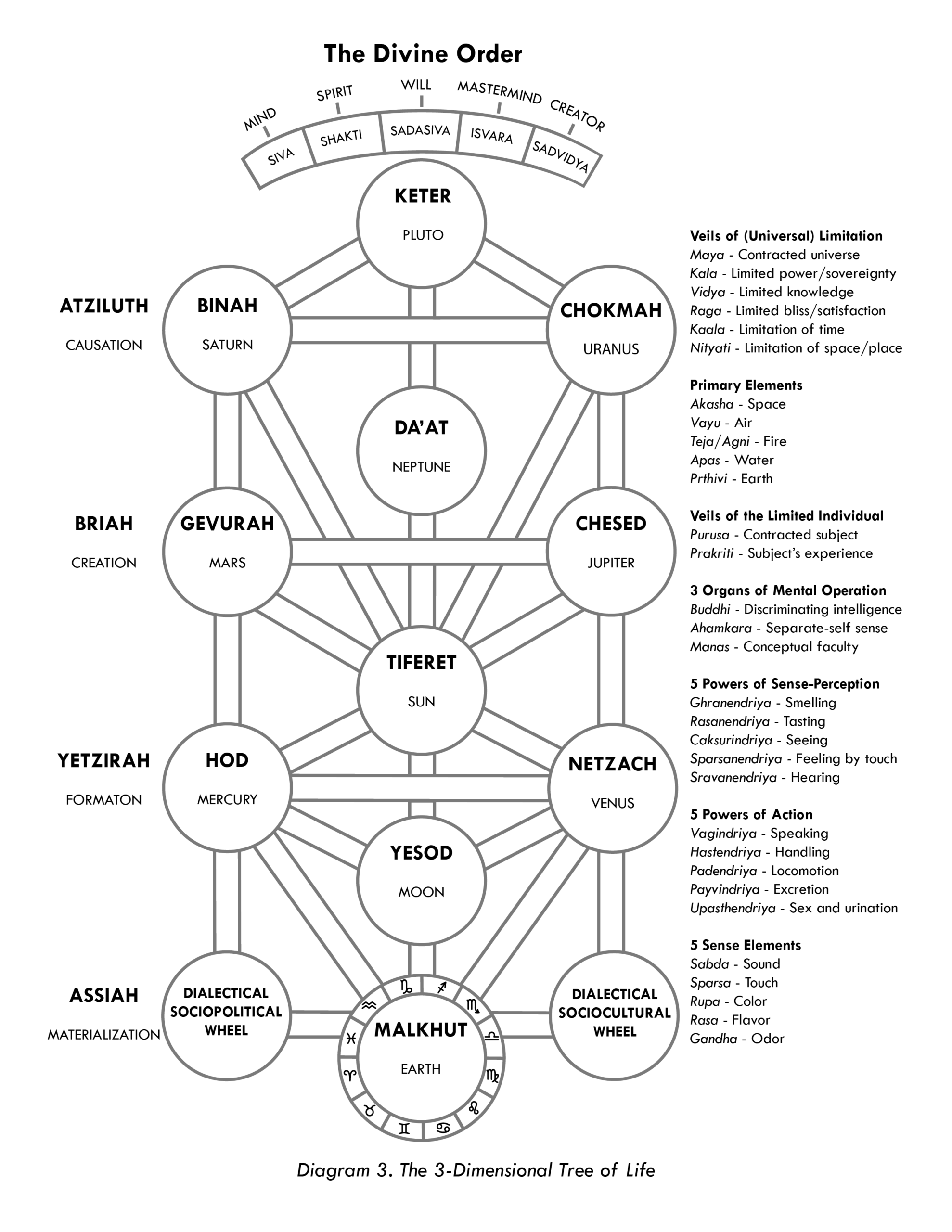
What I’m going to do now, in a series of discussions, is (1) reconsider Kashmir Shaivism (KS), Kabbalah, and phenomenology of Spirit, (2) attempt to creatively combine them, and (3) construct a new Kabbalistic Tree of Life in the process.
My goal in these discussions won’t be to fully elaborate this new Tree of Life (a task that will be continued in my forthcoming Kabbalah book), but to apply the ideas behind the Tree to foster greater insight into the theme we’re now focusing on: nonduality and Mind-Only through the prism of reality. We’ll start our series of discussions with Kashmir Shaivism.
Creation as a Refractive Theophany
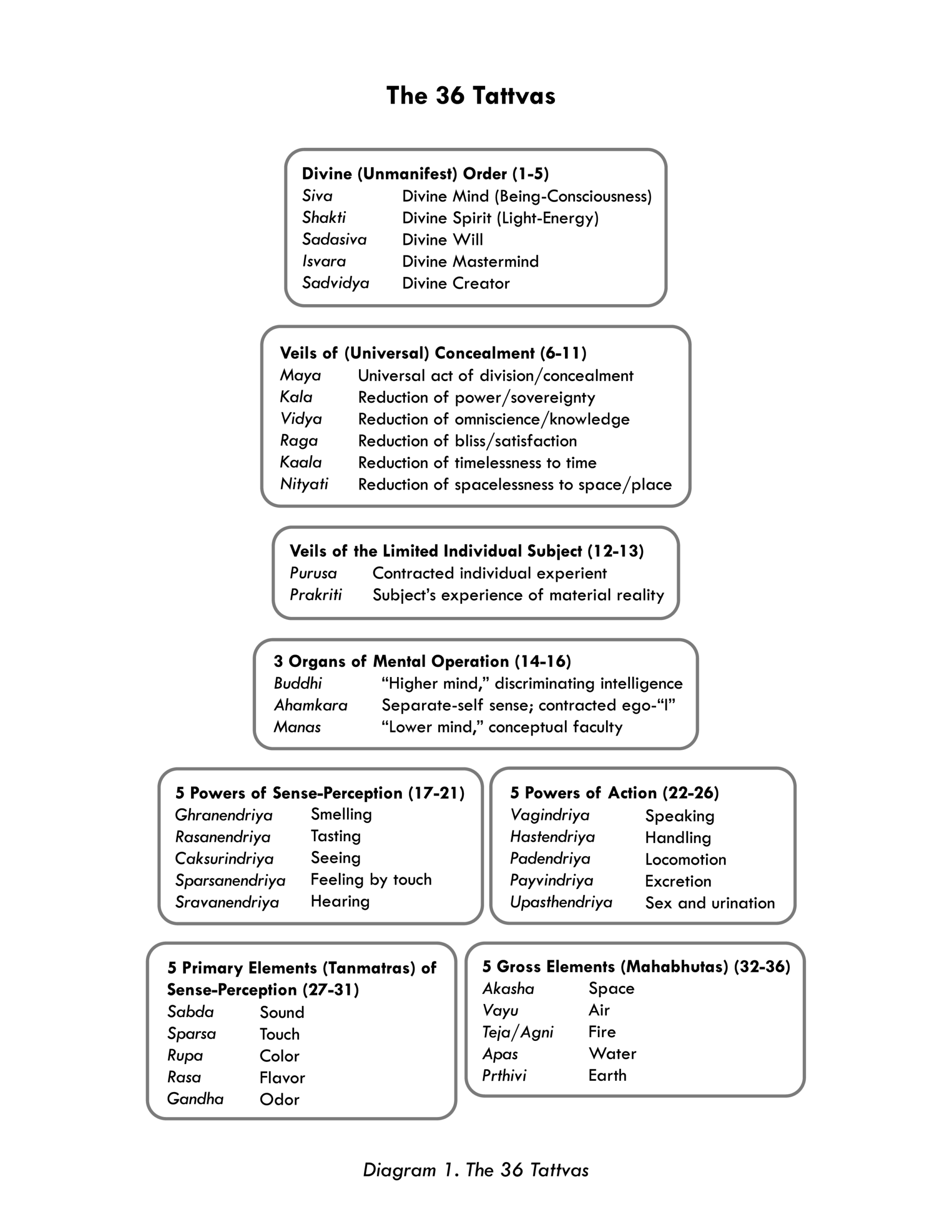
I resonate with Kashmir Shaivism’s five-fold “Divine Order” as a description/imagination of Mind’s (or God’s, or Siva’s) fundamental pre-creation “activity.” Siva, as Shakti, his inseparable Consort, asserts His absolute sovereignty and power as Iccha-Shakti, His will to create. Then, as Jnana-Shakti, He employs His infinite wisdom to “plan” His creation. Finally, as Kriya-Shakti, He, the Immeasurable One, “measures Himself out” as creation, while “hiding Himself” in His theophany.
This fivefold pre-genesis paradigm has Siva, or Cit, as Mind; Shakti as Mind’s Energy; Iccha as Mind’s Will; Jnana as Mind’s Knowledge; and Kriya as Mind’s Creativity. Rather than a static Absolute, as Advaita Vedanta has it, Kashmir Shaivism maintains that the Supreme is not just Cit, but also Shakti, operative prior to and post manifestation.
The KS pre-manifestation description trumps Kabbalah’s because it explains Mind’s transition from acausal God to creator God. And rather than, untenably, describing creation via a muddled cataclysmic act (the shattering of defective vessels), as Kabbalah does, KS provides us with a copacetic depiction of Maya as Siva’s (or Mind’s) Self-organized descent into Self-limitation and division. So, in my Tree of Life [Diagram 3], I employ KS’s “Divine Order” to represent Siva’s/Mind’s pre-genesis activity.
In his The Doctrine of Recognition, A Translation of Pratyabhijnahrdayam with an Introduction and Notes, Jaideva Singh writes, “The Universe is nothing but an opening out (unmesa) or expansion of the Supreme or rather of the Supreme as Sakti [Shakti].”
Exactly. And because I champion this view, and the current big-name promoters of nonduality and metaphysical idealism don’t, I feel moved to counter their static Consciousness-Only arguments by providing a dynamical Spiritual (or Shakti-based) explanation of the Descent of the Divine Mind into, and as, manifestation.
So, from the KS perspective, what happens when the universe opens out from the Supreme?
The Supreme’s first act as “Creator God,” Kriya-Shakti, is to conceal and limit Himself as Maya. The immediate products of Maya tattva are the five kancukas (coverings), which, in our earlier consideration of KS, I described as follows: kala contracts/cloaks sovereign power; vidya contracts/cloaks omniscience; raga contracts/cloaks bliss; kaala contracts/cloaks timelessness; and nityati contracts/cloaks spacelessness. Maya, in the KS system, does not mean “illusion,primitive but phenomenal reality—manifest space-time existents as contracted/cloaked Siva, who, for sport, created, and hid Himself in, the cosmos.
We’ve now enumerated the first 11 tattvas (which constitute the five-fold “Divine Order,” Maya, and the 5 kancukas). From this point, I’m going to deviate from the KS tattva order by placing the mahabhutas (tattvas 31-36, per KS) as 12-17 in my order. In our previous KS discussion, I provided the rationale for inserting the mahabhutas ahead of Purusa and Prakriti, and I’ll now summarily repeat what I said.
The fact that Maya tattva contracts/cloaks spacelessness and timelessness (meaning spaceless, timeless God, or Mind, or Siva) signifies that, as Maya-Shakti, God/Mind/Siva has morphed into the ether (Akasha), the all-pervading space element (or “substance”), and that separate, created existents (or objects) moving/changing successively in that ethereal space results in time. Without the ether and the four fundamental elements that stem from it—fire, earth, air, water—forming a substrate, there can be no further creation, meaning no living Purusa to experience his Prakriti and embody the remainder of the tattvas in the KS hierarchy.
So, instead of the “five gross elements” (mahabhutas), the “tattvas of materiality” (31-36) in the standard KS schema, we now have the “five great elements”— akasha (space), vayu (air), teja or agni (fire), apas (water), and prthivi (earth)—as tattvas 12-16, with Purusa and Prakriti now, respectively, as tattvas 17 and 18.
Purusa and Prakriti are classified as the “tattvas of the limited individual.” As I stated in our previous KS discussion, Purusa is the individual subject, contracted into a point (anu) of self-awareness in the midst of Infinity. It is the Divine Person, Siva, cloaked as an empirical person/experient. Prakriti is the objective material (gross and subtle) manifestation experienced by an individual Purusa. Hence, in contrast to Samkhya philosophy, which equates Prakriti with the total dynamic elemental manifestation, a.k.a. “nature,” KS “personalizes” “impersonal” Prakriti.
I’ll now complete our enumeration of the tattvas by restating what I said in our previous KS discussion (only changing the numbers of the tattvas to agree with our new order). Tattvas 19 (buddhi), 20 (ahamkara), and 21 (manas) are called the “tattvas of mental operation.” Buddhi is the intellect, the discriminating intelligence of the mind. It is sometimes referred to as the “higher mind.”Ahamkara is the separate-self sense, contracted I-consciousness. Manas is the mind that processes and mediates sensory information and habit-tendencies. It is sometimes referred to as the “lower mind.”
The now final tattvas (after our elevation of the mahabhutas ahead of Purusa and Prakriti) are those of “sensible experience” (22-36). These tattvas, which are products of ahamkara, are the “five powers of sense-perception” (jnanendriyas or buddhindriyas): smelling (ghranendriya), tasting (rasanendriya), seeing (caksurindriya), feeling by touch (sparsanendriya), hearing (sravanendriya); the “five powers of action” (karmendriyas): speaking (vagindriya), handling (hastendriya), locomotion (padendriya), excreting (payvindriya), sexual action and restfulness (upasthendriya); and the five “primary elements of perception”(tanmatras): sound-as-such (sabda-tanmatra), touch-as-such (sparsa-tanmatra), color-as-such (rupa-tanmatra), flavor-as-such (rasa-tanmatra), odor-as-such (gandha-tanmatra).
What more can you say about the tattvas?
Plenty, but since our current series of talks focuses on the broad-based themes of nonduality and Mind-Only rather than the specific subject matter of KS, deep delving into the tattvas will have to wait another day. Moreover, the new Kabbalistic Tree of Life that I have “cobbled together” is not a finished product, but a work in progress that I just happened to concoct in the course of our discussions. Hence, in the process of this work, we’ll revisit and further consider the tattvas.


{ 0 comments… add one now }