INTRODUCTION
The Story of This Book
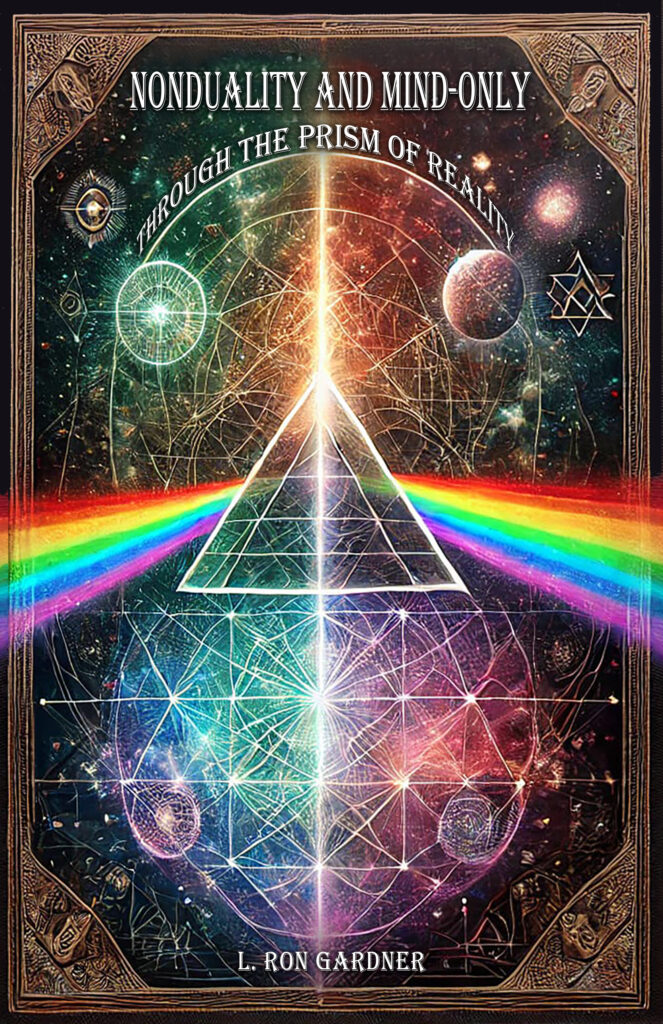
After completing and publishing Zen Mind, Thinker’s Mind and Radical Dzogchen in 2022, I decided that my next writing project would be a Kabbalah book. While beginning work on it, I found myself spending my free time watching YouTube videos on nonduality and Mind (or Consciousness)-Only idealism. This inspired me to read some contemporary books on these subjects. In short, neither the books nor the YouTube videos impressed me; so I decided to put my Kabbalah book on hold and first write Nonduality and Mind-Only through the Prism of Reality.
Because the Mind-Only idealism that I subscribe to involves explaining emanation and creation, I knew that I’d be able to integrate my seminal Kabbalistic insights into my thesis and paradigm, effectively killing two birds with one stone. I also knew that by adding Kashmir Shaivism metaphysics and Hegelian phenomenology of Spirit to my paradigm, I would be able to provide a unique and profound description of the “prismatic” intermundia between unmanifest Mind, the Supreme Source (of emanation and creation), and the terrestrial world we humans inhabit.
I also knew that engaging my sharpest students in discussions on nonduality and Mind-Only would not only lead me to new insights on the subject matter (which it especially did regarding the Kabbalistic Tree of Life), but also provide an agreeable Socratic format for the book. I’ve freely edited and added to my exchanges with my students in order to provide pithy and provocative dialogue that I think most readers will find worthy of serious contemplation.
Unlike most spiritual writers, I’m not the least shy about professing and promoting what I consider to be right spiritual politics. And given the current uber-polarized political climate, I felt it was apropos to extend the quasi-Hegelian phenomenology of Spirit analysis that I employ throughout my book into a consideration of the recent and present sociopolitical and sociocultural zeitgeist. Although the zeitgeist is always changing, the arguments I make for right spiritual politics aren’t; they are perennial and always hold true, cohering with dualistic man’s nature in a nondual universe.
Now, a forewarning to those averse to open controversy, blatant irreverence, acidic criticism of others, and political incorrectness: My writings are teeming with them. My mantra is: “Dale Carnegie I ain’t.” My modus operandi, a la Howard Cosell, is: “I just tell it like it is (or how I perceive it), and let the chips fall where they may.” So prepare yourself for the unrepentant “blasphemy” you are about to encounter in this book.
Summary of This Book
The book consists of sixteen chapters, which I’ll now summarize:
Chapter 1. “Nonduality and Mind-Only”: Explains what nonduality, Mind, and Mind-Only mean, providing the first “base” for the book to build upon.
Chapter 2. “Reality and reality”: Differentiates Ultimate (unmanifest, spaceless- timeless) Reality from phenomenal (manifest, space-time) reality, providing the second “base” for the book to build upon.
Chapter 3. “Huang Po and the One Mind”: Presents Zen master Huang Po’s Dharma to illustrate reductive Mind-Only teachings that don’t explain the “bridge” between Ultimate Reality (Mind) and phenomenal reality (Maya).
Chapter 4. “The Lankavatara Sutra and the One Mind”: Elaborates the Lankavatara Sutra, the foremost Yogacara text, as a veiled doctrine of Divine Descent of Mind (Dharmamegha) into yogis (bodhisattvas), and properly explains reality as a manifestation of (universal) Mind rather than a projection of the (individual) mind.
Chapter 5. “Kashmir Shaivism: The Involution of Ultimate Reality”: Elaborates the 36-tattva (constituent-principle) system of Kashmir Shaivism (KS), which “maps” how Mind (or Siva), as uncontracted Consciousness-Energy (Siva-Shakti), “plans” and then “rolls out” the universe as Maya (contracted Siva-Shakti), which veils the recognition of Mind (or Siva) from embodied beings (samsarins), who must, through the practice of yoga, seek to regain their Divine status as immanent, uncontracted Siva.
Chapter 6. “The Perversion of Kashmir Shaivism’s Mind-Only Doctrine”: Critiques Christopher Wallis’s KS teachings, reviews his book The Recognition Sutras, and finds Wallis, perhaps the most popular Western teacher of tantra and KS, guilty of the perversion of Kashmir Shaivism—especially its Mind (or Consciousness)-Only doctrine. Sadhguru is also identified as guilty of tantric Shaivism perversion.
Chapter 7. “Kabbalah: The Descent of the Divine through the Four Worlds”: Reviews/critiques canonical Kabbalah/Qabalah books and teachings, and rejects them as satisfactory descriptions/explanations of the theosophical Kabbalah and the Tree of Life. A seminal new Tree-of-Life theosophy is then presented, which explains the relationship (including the cosmological history) between Mind (Creator) and manifestation (creation).
Chapter 8. “Beyond The Phenomenology of Spirit, Part 1”: Explains Hegelian idealism and dialectic, briefly considering them in the contexts of epistemology, spirituality, Marxism, and sociopolitics.
Chapter 9. “The Prismatic Paradigm, Part 1”: Introduces my “Prismatic Paradigm,” which creatively combines Kashmir Shaivism, Kabbalah, and phenomenology of Spirit to construct a new Kabbalistic Tree of Life, which, as an integral Mind/manifestation schema, views creation as a refractive theophany. The focus of this discussion is mainly on Kashmir Shaivism in relation to the Prismatic Paradigm.
Chapter 10. “The Prismatic Paradigm, Part 2”: Continues my consideration of the Prismatic Paradigm, with the focus mainly on the Tree of Life and astrology.
Chapter 11. “Beyond The Phenomenology of Spirit, Part 2”: Continues my consideration of the phenomenology of Spirit as it pertains to sociopolitics. The “Dialectical Sociopolitical Wheel” is introduced as a sphere in my new Kabalistic Tree of Life, and the two pertinent dialectical oppositions—capitalism vs. socialism and individualism vs. statism—are considered, along with the sociopolitics of Ken Wilber, Adi Da Samraj, and Klaus Schwab.
Chapter 12. “Beyond The Phenomenology of Spirit, Part 3”: Introduces the “Dialectical Sociocultural Wheel” as a sphere in my new Kabbalistic Tree of Life and designates self-identity/self-expression versus relationships/partnerships as its horizontal axis and home/family versus livelihood/life mission as its vertical axis. This chapter focuses on the horizontal axis and its subversion by cultural Marxism.
Chapter 13. “Beyond The Phenomenology of Spirit, Part 4”: Elaborates the vertical axis of the Dialectical Sociocultural Wheel, explaining how, in the current zeitgeist, the dialectic of home/family versus livelihood/life mission is, like the horizontal axis of self-identity/self-expression versus relationships/partnerships, being subverted by cultural Marxism.
Chapter 14. “Present-Day Nonduality and Mind-Only Teachings”: Considers the words/works of prominent nonduality/Mind-Only authors Robert Wolfe, Rupert Spira, Bernardo Kastrup, Donald Hoffman, Jay Michaelson, and David Loy, exposing them as wisdom-deficient and disintegral.
Chapter 15. “Top-Down Monistic Idealism/Bottom-Up Dualistic Realism”: Summarizes my idealist view as “top-down monistic idealism/bottom-up dualistic realism,” which contends that universal, spaceless-timeless Mind (or Consciousness), the Real, has become everything, the totality of space-time existents; and once Mind, via its inseparable Shakti, rolls out the universe of phenomenal existents, then duality—meaning separate space-time entities and consequent subject-object relations—ensues, and this manifest, dualistic reality is real, not an illusion, because nothing unreal can come from the Real.
Chapter 16. “Power-of-Now Meditation (Holy Communion)”: Provides Power-of-Now Meditation/Divine (or Holy) Communion instructions that explain how to access the timeless Now (or Divine Presence) and receive (or conduct) its en-Light-ening Energy (or divinizing Power), and thereby experience the Spirit-full Reality of Mind-Only nonduality. Excerpts from my book Electrical Christianity (“The Practice of True Holy Communion,” “Ohm’s Law and Spiritual Energy,” and “Ohm’s Law and the Eucharist”) apply Ohm’s Law and Hegelian dialectic to explain the “mechanics” of spiritual en-Light-enment; and pertinent Kabbalah and Kashmir Shaivism writings provide further light on Divine (or Holy) Communion and Divine (Power-of-Now) Reception.
Because this book contains considerable Buddhist, Hindu, and Kabbalistic terminology, I have included an extensive glossary. As with my previous nonfiction books, I have included my Spiritual Reading List, which I’ve upgraded with new additions.
Every book I write aims to break seminal new ground in the spiritual tradition or topic it covers—sans this aim, I wouldn’t be a spiritual writer. It is my hope that readers will find my goal successful with this book.

{ 0 comments… add one now }