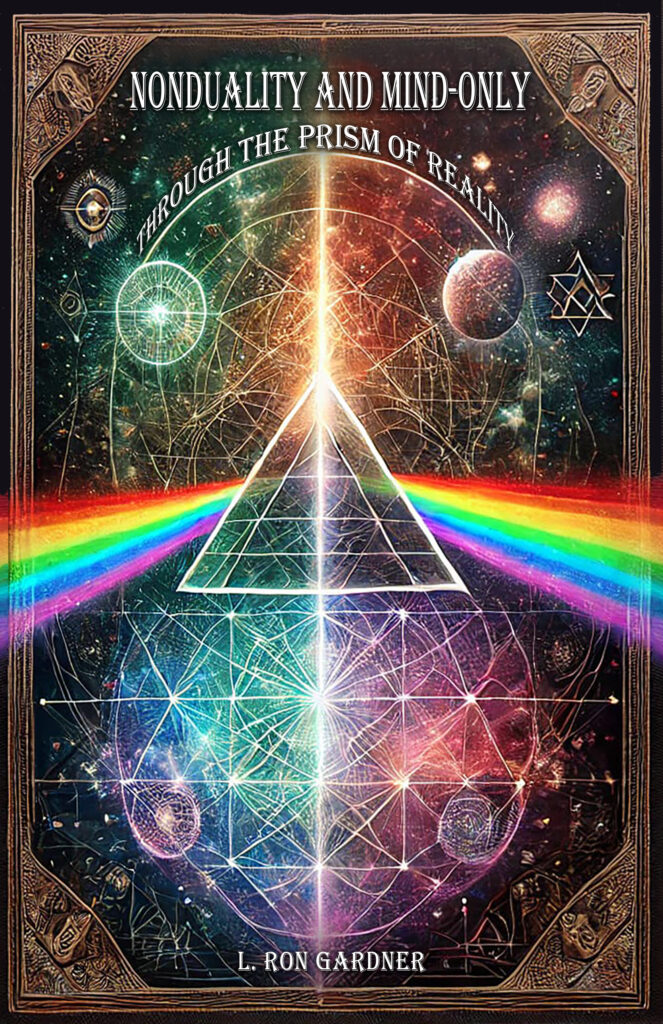
[This is an excerpt from my recently published book, Nonduality and Mind-Only through the Prism of Reality, which is available in Kindle and paperback at Amazon and from other book sellers.]
Okay, this is the last of our discussions on nonduality and Mind-Only metaphysics, so you should summarize your view and how it differs from others.
Okay, this is the last of our discussions on nonduality and Mind-Only metaphysics, so you should summarize your view and how it differs from others.
My view, in a nutshell, can be classified as “top-down monistic idealism/bottom-up dualistic realism.” I contend that universal, timeless, spaceless Mind (or Consciousness), the Real, has become everything, the totality of space-time existents, which all are (phenomenally) real, because nothing unreal can come from the Real. In other words, whatever exists is real, but the ontological status of existents differs and must be hierarchically distinguished.
In accordance with Kashmir Shaivism (KS), I hold that once Siva (Mind, or Consciousness), via its inseparable Shakti, rolls out the universe of phenomenal existents, then duality—separate space-time entities and consequent subject-object relations—ensues, and this manifest, dualistic reality is real, not an illusion.
So, as you’ve said before, from the top-down perspective, Consciousness, as the Progenitor, has primacy over existence, but once Siva, for Divine sport, enacts (and hides Himself in) Maya, then existence has primacy over consciousness, which has been contracted into subject-object duality. And this explains why you can “marry” Kashmir Shaivism with Ayn Rand’s Objectivism, because while KS explains uncreated, nondualistic Reality from the top down, Objectivism “completes it” by explaining created dualistic reality from the bottom up.
Very good. However, I do want to make it clear that although I deeply resonate with both Kashmir Shaivism and Objectivism and freely integrate their philosophies with my own, I do not agree with every aspect of their teachings. Likewise, people can freely incorporate aspects of my philosophy into their own, while not necessarily agreeing with everything I teach or write. In fact, I encourage this type of discriminating integration.
But Rand was an atheistic anti-mystic, which flies in the face of your God-oriented mysticism.
My view regarding Rand is the same as my view regarding Adi Da Samraj (whom I also receive flak for liking and “milking”): Don’t throw the baby out with the bath water. Despite my major differences with aspects of their teachings (and behavior), I confess that I could not have “cracked the code” of the Enlightenment project sans their influence. As Ken Wilber puts it, “Even if Einstein was a complete psychotic, E still equals mc2.”
In addition to your unique top-down/bottom-up perspective on nonduality and Mind-Only, what stands out in your paradigm is your integration of Kashmir Shaivism’s 36-tattva schema and Kabbalah’s Sefirotic Tree of Life as explanatory links that connect the “top” (the Divine Realm of Mind) with the “bottom” (the world).
Yes. Although I plan to further develop my descriptions of these links, I think that what I’ve provided in our talks provides a solid basis for theosophically explaining the hierarchical descent of Mind (or Consciousness) as Spirit (or Light-Energy) into matter (the world).
Deism, Monotheism, Pantheism, and Panentheism
What can you say about the pertinent “isms” of theism (deism, monotheism, pantheism, and pantheism) in relation to your paradigm?
I’ll summarize what I perceive each of these “isms” to mean, then answer your question.
Deism: This “ism” supports the existence of a creator God, but rejects the idea that this God actively intervenes in the human world. Deism also rejects the ideas of Divine revelation, the Holy Spirit, the Trinity, and even the idea that holy books contain the Word of God.
Monotheism: Because theism can mean many gods or deities, it is only monotheism (meaning one God) that pertains to a monistic paradigm. Monotheism, exemplified by Christianity, Judaism, and Islam, holds that there is one Supreme Being/Creator God, distinct from His creation, who oversees and intervenes in human events. This God sustains a personal relation with His creatures.
Pantheism: The term “pantheism” derives from the Greek root pan (all) and theos (God). It means that the all, the cosmos, is identical with God, that Creator and creation (the universe) are not distinct from each other.
Panentheism: This term derives from pan (all) en (in) theos (God). Hence, it means that all (the universe) is in God, and God is in all. In other words, God transcends the world but is immanent in it.
Millions of words have been written on each of these “isms” (not to mention their interrelatedness, or lack thereof); so my summary is hardly the final or full word on their respective meanings. That said, it should be clear that my paradigm most closely aligns with panentheism, which is compatible with top-down monistic idealism/bottom-up dualistic realism.
Although God (or Mind) is immanent in all creatures as Self (or Buddha, or Christ), only man, on planet Earth, was created in “the image of God” and can consciously reflect the Deity. The Soul of man is a far cry from the shit he excretes and flushes down the toilet; so ontological distinctions regarding existents in the world must include their respective capacity to channel or express the Transcendent, the Holy. This, of course, implies dualism, and as I repeatedly make clear, top-down nonduality, meaning a single Mind (or Being-Consciousness) from whence all things stem, is compatible with bottom-up dualism, meaning separate, hierarchically distinct space-time existents, which appear, abide, and disappear in the timeless, spaceless “space” of Mind.
How do you define “Holy”?
Only the Godhead, the Trinity (or Trikaya)—timeless, spaceless, unborn, immaculate Consciousness-Energy—is Holy. When we speak of It as transcendent, it is Father; when we speak of It as immanent, It is Son; and when we speak of It as Energy (which links the Father and the Son), It is Spirit. The Holy One, the Godhead, is in the world, but not of it. The Holy One is ever nondual, because His “three dimensions” (Father/Dharmakaya, Son/Buddha, Spirit/Sambhogakaya) are intradivine; hence there is no dualistic “other” in the Godhead, but simply the three principal aspects of the “three-in-one” Deity, or Mind.
Nothing manifest (or born) is Holy, because everything created is compounded and subject to decay. Created objects (such as temples, holy books, and divine artifacts) can allude to the Unmanifested, the Uncompounded; but they themselves, as temporary appearances in space-time, are not truly Sacred, or Holy.
So the Holy is nondual, while the non-Holy is dual.
Yes. The non-Holy, meaning space-time existents, arise in, and of, Mind, but are not Mind. They are phenomenally real, but not Ultimately Real (or Holy). Mind, as Light-Energy, or Spirit-Power, through the medium of Maya, manifests as the entire spectrum of stepped-down energies, life forms, and matter. Although nondual, unmanifest Mind, via its Shakti, has become everything, it has not become anything, never being implicated in its own dualistic manifestation.
So how can one realize the reality of what you’re saying?
First, theosophically, by comprehending the reality of intelligent design by an unmanifest Divine Mind that subsumes the manifest universe of existents, and by acknowledging the wisdom of countless mystics and yogis throughout history who attest to the Reality of the nondual Holy Mind. Second, yogically, by mystically apprehending/contemplating/channeling the Holy Spirit, experiencing at-one-ment with it, and radically intuiting the nondual Reality that transcends the dualistic phenomenal world. Third, Spirit-fully/gnoseologically, by receiving the full, culminating descent of Divine Power (Clear-Light-Energy from above) that severs one’s Heart-knot, yielding integral Self-Realization, and the direct seeing/knowing that everything which appears or exists is a temporary modification or permutation of the Light-Energy of Mind (the all-encompassing Supreme Being-Consciousness, or Holy One).
The first way is readily accessible to intelligent, clear-thinking individuals, such as the iconic quantum physicist Erwin Schrodinger (1887-1961), who said, “The total number of minds in the universe is one. In fact, consciousness is a singularity phasing within all beings.” To such individuals, it is apparent that a single Divine Mind is the Matrix from which manifest existence and individual consciousness derive.
The second way is accessible to individuals who have been baptized by, and regularly abide in, the Holy Spirit, Divine Shakti from on high. Abidance in the Holy Spirit, the true Power of Now, which is Clear-Light Energy, bestows one with mystical gnosis of Mind as an all-subsuming, radiant Force-Flow.
The third way is accessible only to the rarest of beings, mahasiddhas (spiritually perfected adepts), who, by virtue of having cut the spiritual Heart-knot (felt-experienced two digits to the right of the center of one’s chest), rest unbrokenly in the Clear-Light Energy that is ceaselessly absorbed into and emitted from their now open Heart-center. For these beings, it is obvious that everything is a temporary modification or permutation of the timeless Light-Energy of God (or Mind).
How can one become baptized by the Holy Spirit, the Power of Now, and begin to experience Mind as an all-subsuming radiant Force-Flow?
By practicing Power-of-Now meditation/contemplation (true Holy Communion). The book—Nonduality and Mind-Only through the Prism of Reality—that will result from our current series of discussions will contain a final chapter [Sixteen] that details this method.
{ 0 comments… add one now }