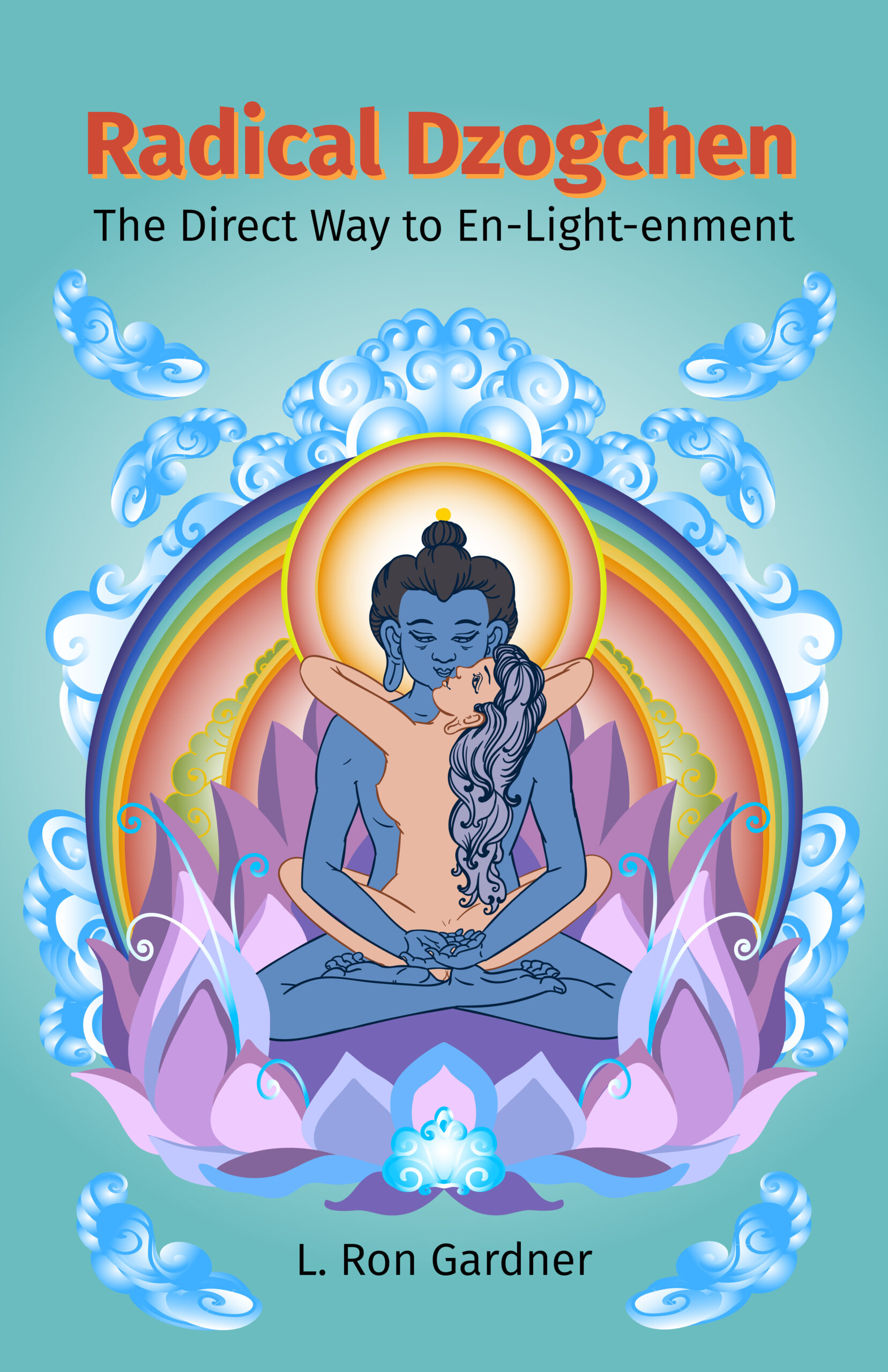
[This is an excerpt from my book Radical Dzogchen: The Direct Way to En-Light-enment, which is available in Kindle and paperback at Amazon and from other book sellers.]
But Dzogchen is about the Great Perfection, which is already the case prior to any attempt to attain Union. Hence, true Dzogchen practice is simply effortlessness.
There has never been, and never will be, a yogi who practiced/practices just “effortlessness” as the means to Enlightenment. The greatest Realizers, including Buddha, Ramana Maharshi, and Milarepa, all had to practice forms of conscious focusing in addition to utter letting go. And even utter letting go doesn’t amount to effortlessness, because one has to exert an effort to remain alert in order to remind oneself to resume “declutching” as soon as one notices oneself grasping. Prior to full Enlightenment, meaning permanent union with Light-Energy, or Spirit, conscious effortlessness for protracted periods of time is not possible.
But in Tilopa’s Song of Mahamudra, he “sings” that “without making an effort, but remaining loose and natural, one can break the yoke, thus gaining liberation.” And Longchen Rabjam, in his teachings, repeatedly enjoins yogis to practice effortlessness.
Both Tilopa and Naropa, whom Tilopa addresses in his Song of Mahamudra, practiced Anuttarayoga Tantra, a set of spiritual practices intended to accelerate the process of attaining Buddhahood. And Naropa taught his Six Yogas of Naropa rather than just effortlessness, because he knew that effortlessness alone does not cut it as a sadhana. But my heretical take is that neither Tilopa nor Naropa understood what “Mahamudra” really means, which is “Great Gesture.” “Maha” means “Great” and “Mudra” means “Gesture”—and this “Great Gesture” is the “Sacrament” (or Sacred Enactment) of Holy Communion, or Yogic At-One-Ment. In other words, the essence of Mahamudra is not effortlessness, but the practice of what I call Plugged-in Presence. This practice generates maximal consciousness-force (or “voltage”), and if it is understood as a synonym for Mahamudra, then there is no need to supplement low-energy, or “effortless,” Mahamudra with tantric practices. Rather, “effortlessness,” or utter letting go (or “ohms reduction”), becomes the “yin” complement to the “yang” practice (or “Gesture,” or “Enactment”) of Yogic At-One-Ment, or Plugged-in Presence.
In his Yogic Commentary in the classic W.Y Evans-Wentz text Tibetan Yoga and Secret Doctrines, Translator-Professor Chen-Chi Cheng writes: “The Six Yogas are productive of more yogic power than Mahamudra... Traditionally, the Mahamudra has been prescribed as a mild antidote, and the Six Yogas as a strong antidote, for Ignorance.” In other words, because Tilopa and Naropa failed to properly present Mahamudra as direct, immediate conscious at-one-ment, or plugged-in presence, but instead promoted it as passive letting go and self-emptying, it lost its mojo as a “strong antidote for Ignorance,” and thus needed to be supplemented with other practices, such as the Six Yogas.
The ramifications of Tilopa and Naropa’s misrepresentation of Mahamudra can be seen in the historical presentations of the teachers that followed them. Because none of these Mahamudra teachers of old (including the iconic Dako Tashi Namgyal) or new (such as Geshe Kelsang Gyatso) grokked/grok the true meaning and practice of Mahamudra, they had to incorporate “voltage” practices to compensate for the perceived lack of “yogic power” in Mahamudra.
Because effortlessness, or non-meditation, alone is insufficient as a sadhana, Mahamudra developed into a four-phase practice: one-pointedness, simplicity, one taste, and non-meditation. From an “electrical-spiritual” perspective, one-pointedness is a match for voltage, and non-meditation for (maximal) ohm’s reduction. Simplicity (non-judging) and one taste (seeing all phenomena as empty) are “in-between” practices that involve degrees of one-pointedness (or focused attention) and non-meditation (or effortlessness).
In his Song of Mahamudra, Tilopa describes the yogi’s En-Light-ened mind thus: “In the end, it is a great vast ocean, where the Lights of Son and Mother merge in one.” The Mother Light—really Mother Light-Energy, or Sambhogakaya—is the Spirit-current (amperage). So, from an “electrical-spiritual” perspective, one-pointedness (voltage) is the thesis, non-meditation (ohms reduction) is the antithesis, and the Mother Light-Energy, which subsumes the Son Light (the yogi’s consciousness), is the synthesis, which “produces” En-Light-enment, realization of the Dharmakaya.
Longchen Rabjam contradicts himself on effortlessness. In The Precious Treasury of the Way of Abiding and A Treasure Trove of Scriptural Transmission: A Commentary on The Precious Treasury of the Basic Space of Phenomena, he’s a salesman for trekcho and effortlessness, but in Precious Treasury of the Genuine Meaning, he emphasizes the shortcomings of (what he considers) the effortless practice of trekcho, and instead promotes the superiority of the effortful practices of togal. If he’d known of my Electrical Spiritual Paradigm (ESP), he’d have understood how, in a Dzogchen context, to resolve the effortlessness/effort dialectic by providing the spiritual synthesis that integrates it.
{ 13 comments… read them below or add one }
Sir,
Do you consider the late Sailor Bob Adamson ( a student of Sri Nisargadatta Maharaj) as an enlightened spiritual master at the highest level or league of Sri Ramana Maharshi? When I expressed my doubts to an Australian lady she got offended and told me that he was infact several levels above Sri Ramana Maharshi. Is this really true?
No, I don’t consider the late Sailor Bob an Enlightened spiritual master at the highest level or in the league of Ramana Maharshi. And I don’t consider Nisargadatta to be in the league of Ramana Maharshi, either. Sailor Bob’s spent a year with Nisargadatta. Like Nisargadatta’s teachings, Sailor Bob’s are bereft of esoteric and energetic dimensions.
Sir,
Thanks for responding. I totally agree with you on this. I don’t know much about his teacher Sri Nisargadatta. When I watch Sailor Bob’s videos there is nothing there other than him saying we are already that which are are seeking, we are already that totality even now, there is no such thing as enlightenment, Self-realization, moksha or sahaja nirvikalpa samadhi, the jiva or ego is non existent, no effort is needed to be who we already are, what we are is only the silent, empty cognisant awareness etc.
Also the fact that he married a very young woman by the name of Kat who was in her twenties while he was in his nineties is very unusual for a fully enlightened sage that his followers claim him to be.
He never talks about suffering of the ego, suffering and sorrow in this life and from future births and deaths etc. All he says is what is wrong with right now if we don’t think about it. How is that possible for anyone to do so is beyond me. It is very surprising people in Australia are content with such a dubious, mediocre, spiritually unawakened and uninspiring fellow.
Hey Ron,
This comment is a bit unrelated to this post but I wanted to know you thoughts on this since you hold those three texts of Ramana Maharshi in such high regard.
The following is an excerpt from David Godman’s website regarding the authenticity of a few texts of Ramana Maharshi. I am curious to know your thoughts about it.
” I would regard Guru Vachaka Kovai as the most authoritative collection of Bhagavan’s verbal teachings. Next, in order of authenticity and reliability, are the records of conversations that appeared during Bhagavan’s lifetime which were checked and edited by him prior to publication. This list would include Maharshi’s Gospel, Spiritual Instruction, and to a lesser extent the talks that precede Sat Darshana Bhashya.
There is a proof copy of the first edition of Maharshi’s Gospel in the Ramanasramam archives which shows that Bhagavan made minor handwritten revisions to the text prior to its publication.
Spiritual Instruction has always appeared in The Collected Works of Ramana Maharshi, even though it is a record of answers Bhagavan gave out, rather than a written work. All the items that appeared in the Tamil edition of Collected Works have been thoroughly checked by Bhagavan himself.
The dialogues that precede Sat Darshana Bhashya were read to Bhagavan by Kapali Sastri prior to their publication. As he was listening to them, Bhagavan made suggestions that were all incorporated. K. Natesan, who was present in the hall on the day of the reading, told me that Bhagavan asked Kapali Sastri to change one phrase to ‘import of I’ – a nice English phrase – but he couldn’t remember what words it replaced. Though Bhagavan listened to this reading and made a few suggestions that were accepted, there are several comments that were attributed to Bhagavan in the work that I doubt very much he said. These remarks support an interpretation of Bhagavan’s teachings that was espoused by Ganapati Muni and Kapali Sastri, but which Bhagavan refuted on other occasions. I suspect Kapali Sastri put these words into Bhagavan’s mouth, and Bhagavan, knowing that Kapali Sastri subscribed to these views, was unwilling to make adverse comments on them when they were read out to him in the hall.
This is a feature of Bhagavan’s editing that I will return to later. Some people, such as Muruganar, had their texts vigorously edited by Bhagavan, whereas others were allowed to get away with somewhat dubious statements because Bhagavan didn’t invest the same energy in correcting their manuscripts.
Sri Ramana Gita, which was also published during Bhagavan’s lifetime is, to my mind, extremely problematic. It was not shown to Bhagavan prior to its publication, and G. V. Subbaramayya has recorded an incident in which Bhagavan wanted to change the original Sanskrit of one verse because a particular term was inappropriate. The first edition was not published by Sri Ramanasramam, but when the ashram took over the book, subsequent editions were checked by Bhagavan before they were printed. Bhagavan also took care to ensure that the editions of Sri Ramana Gita that were published in other languages were accurate. I visited K. K. Nambiar in Chennai in the early 1980s and he showed me the Malayalam edition of Sri Ramana Gita that he and Bhagavan had worked on together. Bhagavan had eventually written out all eighteen chapters in Malayalam, and this handwritten copy was sitting on Nambiar’s altar when I visited. He told me that he recited the whole work in Malayalam every day as parayana.
Ganapati Muni, the devotee who recorded Sri Ramana Gita, had a photographic memory, and Bhagavan has gone on record as saying that the teachings recorded there are an accurate presentation of the conversations that took place. However, he was not so happy with the questions themselves or with the motives that lay behind them.
Around 1980 Sadhu Om interviewed Sadhu Natanananda about various events that had taken place during Bhagavan’s lifetime and the conversation was recorded on an audio tape. Sadhu Om and Michael James made an English translation of this conversation shortly afterwards, and Michael was kind enough to give me a copy.
Sadhu Natanananda said during the interview that shortly after he had arrived at Ramanasramam he had asked Bhagavan about the contents of Sri Ramana Gita because he didn’t read Sanskrit himself. Bhagavan told him that he didn’t need to read the text.
Then Bhagavan told him, ‘They came to me, not to get knowledge of my teachings, but to convert me to their own. They tried to get me to agree with them, but I refused. Even though I wouldn’t say what they wanted me to say, they went ahead and published the book. This is a bit like a high-wire circus artist who falls off the wire, does a somersault on the way down to the safety net, and then pretends that falling off was all part of the act.’
This is harsh criticism indeed, but it didn’t stop Bhagavan from doing his usual thorough job of editing and translating the editions of this book that came out in the last few decades of his life. The book was popular with many devotees and Bhagavan took great care to ensure that all editions of it were accurate and well translated.”
Again, thank you for the comment.
Hey Ron,
The following is an excerpt from David Godman’s website regarding the authenticity of a bunch of ramana maharshi’s books. I have added the portion concerned with those three texts of ramana maharshi which you hold in high regard. I am extremely curious to know about your thoughts on it.
” I would regard Guru Vachaka Kovai as the most authoritative collection of Bhagavan’s verbal teachings.
Next, in order of authenticity and reliability, are the records of conversations that appeared during Bhagavan’s lifetime which were checked and edited by him prior to publication. This list would include Maharshi’s Gospel, Spiritual Instruction, and to a lesser extent the talks that precede Sat Darshana Bhashya.
There is a proof copy of the first edition of Maharshi’s Gospel in the Ramanasramam archives which shows that Bhagavan made minor handwritten revisions to the text prior to its publication.
Spiritual Instruction has always appeared in The Collected Works of Ramana Maharshi, even though it is a record of answers Bhagavan gave out, rather than a written work. All the items that appeared in the Tamil edition of Collected Works have been thoroughly checked by Bhagavan himself.
The dialogues that precede Sat Darshana Bhashya were read to Bhagavan by Kapali Sastri prior to their publication. As he was listening to them, Bhagavan made suggestions that were all incorporated. K. Natesan, who was present in the hall on the day of the reading, told me that Bhagavan asked Kapali Sastri to change one phrase to ‘import of I’ – a nice English phrase – but he couldn’t remember what words it replaced. Though Bhagavan listened to this reading and made a few suggestions that were accepted, there are several comments that were attributed to Bhagavan in the work that I doubt very much he said. These remarks support an interpretation of Bhagavan’s teachings that was espoused by Ganapati Muni and Kapali Sastri, but which Bhagavan refuted on other occasions. I suspect Kapali Sastri put these words into Bhagavan’s mouth, and Bhagavan, knowing that Kapali Sastri subscribed to these views, was unwilling to make adverse comments on them when they were read out to him in the hall.
This is a feature of Bhagavan’s editing that I will return to later. Some people, such as Muruganar, had their texts vigorously edited by Bhagavan, whereas others were allowed to get away with somewhat dubious statements because Bhagavan didn’t invest the same energy in correcting their manuscripts.
Sri Ramana Gita, which was also published during Bhagavan’s lifetime is, to my mind, extremely problematic. It was not shown to Bhagavan prior to its publication, and G. V. Subbaramayya has recorded an incident in which Bhagavan wanted to change the original Sanskrit of one verse because a particular term was inappropriate. The first edition was not published by Sri Ramanasramam, but when the ashram took over the book, subsequent editions were checked by Bhagavan before they were printed. Bhagavan also took care to ensure that the editions of Sri Ramana Gita that were published in other languages were accurate. I visited K. K. Nambiar in Chennai in the early 1980s and he showed me the Malayalam edition of Sri Ramana Gita that he and Bhagavan had worked on together. Bhagavan had eventually written out all eighteen chapters in Malayalam, and this handwritten copy was sitting on Nambiar’s altar when I visited. He told me that he recited the whole work in Malayalam every day as parayana.
Ganapati Muni, the devotee who recorded Sri Ramana Gita, had a photographic memory, and Bhagavan has gone on record as saying that the teachings recorded there are an accurate presentation of the conversations that took place. However, he was not so happy with the questions themselves or with the motives that lay behind them.
Around 1980 Sadhu Om interviewed Sadhu Natanananda about various events that had taken place during Bhagavan’s lifetime and the conversation was recorded on an audio tape. Sadhu Om and Michael James made an English translation of this conversation shortly afterwards, and Michael was kind enough to give me a copy.
Sadhu Natanananda said during the interview that shortly after he had arrived at Ramanasramam he had asked Bhagavan about the contents of Sri Ramana Gita because he didn’t read Sanskrit himself. Bhagavan told him that he didn’t need to read the text.
Then Bhagavan told him, ‘They came to me, not to get knowledge of my teachings, but to convert me to their own. They tried to get me to agree with them, but I refused. Even though I wouldn’t say what they wanted me to say, they went ahead and published the book. This is a bit like a high-wire circus artist who falls off the wire, does a somersault on the way down to the safety net, and then pretends that falling off was all part of the act.’
This is harsh criticism indeed, but it didn’t stop Bhagavan from doing his usual thorough job of editing and translating the editions of this book that came out in the last few decades of his life. The book was popular with many devotees and Bhagavan took great care to ensure that all editions of it were accurate and well translated.
I should like to put the spotlight now on Talks With Sri Ramana Maharshi, the biggest published collection of dialogues with Bhagavan. The first thing to note is that Bhagavan never checked and revised this book in the way that he did with Guru Vachaka Kovai or the other books of conversations that appeared during his lifetime. A portion of the original manuscript, recorded by Munagala Venkataramiah in the 1930s, still exists. There are various editing and correction marks in it done by devotees of that era, but none of the marks is by Bhagavan. Annamalai Swami and Sadhu Om both told me that they saw Bhagavan reading parts of the manuscript in the hall, but at no point did he make any attempt to edit or change what was there.
There are several factors that need to be weighed when one is assessing the reliability of what appears in this book:
(a) No one ever recorded Bhagavan’s voice. All the dialogues that appear were written down from memory.
(b) Munagala Venkataramiah was not always allowed to write down what Bhagavan said at the time he said it. For some time Chinnaswami enforced a rule that no one was allowed to take any notes in the hall. During these periods Munagala Venkataramiah had to wait till he got back to his room, often several hours later, before he could commit his memories of conversations to paper.
(c) Munagala Venkataramiah had a reputation for adding comments of his own when he acted as Bhagavan’s translator in the hall. Some of these additional comments found their way into his manuscript.
(d) Munagala Venkataramiah was not the sole recorder. Visitors who had had conversations with Bhagavan when Munagala Venkataramiah was absent sometimes wrote up their own versions of these conversations and passed them on to Munagala Venkataramiah. These contributions can only be as reliable as the people who made them. Munagala Venkataramiah sometimes edited these contributions, and sometimes incorporated them without changes. Talk numbers 530-47, for example, were recorded by Annamalai Swami in his own diary. Munagala Venkataramiah heavily edited many of these entries.
(e) Other people such as S. S. Cohen, who were also recording dialogues during this period, sometimes have quite different versions of the same conversation.
When my comments about the provenance of Talks were first posted online, I received an email from Ajay Kumar that pointed out that Major Chadwick had given its accuracy a much higher rating in his introduction to the book:
The completed notes were often shown to questioners for verification, but the whole had the seal of approval of Sri Bhagavan himself, as the records were always shown him for his approval or the necessary alteration after they had been entered in the notebook. Thus we may be sure that here we have the exact teaching of the Master.
Most of what follows is the reply that I sent him:
When one is attempting to evaluate the accuracy of a particular text that was in existence in Bhagavan’s lifetime, it is important to recognise a distinction between something Bhagavan read and something Bhagavan actually corrected and revised. I am sure that huge portions of the Talks manuscript would have been quite acceptable to Bhagavan had he taken the trouble to edit it for publication, but the fact remains that he didn’t.
Parts of the Talks manuscript did appear in Maharshi’s Gospel, which came out in 1939. The second half of Maharshi’s Gospel contains dialogues that do not appear anywhere else. I strongly believe that they were dialogues that Maurice Frydman, the editor of the book, had with Bhagavan but I can’t prove this conclusively because he covered his tracks very well. The first half of Maharshi’s Gospel, though, comprises conversations that were lifted verbatim from the Talks manuscript. Judging by the small number of alterations that were made to the Maharshi’s Gospel proof copy by Bhagavan, one can infer that he was reasonably happy with the text in the manuscript.
Chadwick stresses that ‘we may be sure that here [in Talks] we have the exact teaching of the Master’. I am not so convinced, and the reason I say this is that there is one excellent bench mark against which the accuracy of Talks can be measured. In 1936 Bhagavan gave a deposition in a court case. This took place in the hall, and devotees were allowed to attend. The court stenographer made a verbatim transcript of everything Bhagavan said, while Munagala Venkataramiah made notes that he later included in Talks. The full dialogue can be found in the article I wrote entitled Bhagavan the Atiasrami. I will just give a couple of extracts from it to illustrate the point I am trying to make. They are from 5th December, 1936:
Munagala Venkataramiah’s version:
Question: Who is your Guru?
Bhagavan: The Self.
Question: For whom?
Bhagavan: For myself. The Guru may be internal or external. He may reveal himself internally or externally.
The only reply recorded by the court stenographer on this topic was:
Bhagavan: For me Atma itself is the Guru. My Atma is Guru for my Atma.
Munagala Venkataramiah again:
Question: You spoke of atiasrama the other day. Is there authority for it? Is it mentioned anywhere?
Bhagavan: Yes, in the Upanishads, the Suta Samhita [Skanda Purana], Bhagavata, Bharata and other works.
This is the court record of Bhagavan’s reply to this question:
Bhagavan: Details about atiasrama are contained in the Suta Samhita.
If you compare the two sets of questions and answers, you will see that some of Munagala Venkataramiah’s transcriptions are decidedly off the mark. Not only does he fail to record the answer to the key question ‘Who is your Guru?’ correctly, he also pads it out with additional comments that Bhagavan did not make. The additional comments are remarks that Bhagavan did make on this subject on other occasions, but on this particular day he restricted himself to what the stenographer recorded. This habit of padding out the answers can also be seen when Bhagavan gives a scriptural citation for atiasrama (the Suta Samhita). Munagala Venkataramiah added the Upanishads, the Bhagavata and the Mahabharata to the list. These works may contain material on this subject, but they were not cited by Bhagavan during this deposition.
These two examples should be enough to demonstrate the point I am trying to make. I have spoken to many devotees who were present in the hall in the 1930s when Munagala Venkataramiah was the principal translator. Most of them told me that he regularly added his own comments to what Bhagavan said. When he wrote down the conversations later, many of these additional comments found their way into his record. The additional comments were usually remarks that Bhagavan had made on the same subject on different occasions, so they were not entirely inappropriate, but I feel there was no justification for padding out Bhagavan’s comments in this way. Bhagavan, who had a good grasp of English, must have known what was going on, but he didn’t interfere unless his own words had been mistranslated in some way. I have been told that when Devaraja Mudaliar translated for the first time in the early 1940s, Bhagavan beamed with pleasure and said words to the effect, ‘Finally, someone who translates exactly what I say’. I have heard three different versions of this comment from devotees who were with Bhagavan in the 1940s, and this is a summary of the gist of all three of them.
Having said all this, I have to say that Talks with Sri Ramana Maharshi is one of my favourite books of Bhagavan’s teaching. One can feel the power of Bhagavan’s words and teachings on every page. It may not be exactly what Bhagavan said, but his teachings are simple and clear enough to withstand the occasional embellishment.”
Mumukshu, thank you for the comment. I’m sure many here will find it interesting and informative.
But ron, do you still think that the esoteric sentences (found in those 3 books) uttered by maharshi were truy uttered by him? Especially the talks about Nadi, Heart-Knot etc. I am quite wary about it, because maharshi never mentioned such topics in the remaining of his discourses.
Looking forward for a detailed reply
Yes, I think they were uttered by him.
But Ron, What are your thoughts about their authenticity? Do you think that most of those esoteric utterances were of maharshi himself? I am quite wary about it, given the fact that maharshi never spoke of such esoteric stuff in almost all of his remaining discourses throughout life.
I think they are authentic.
Mr. Gardner,
It looks like the person ca_cicero a k a Matt, Paul, jivanmukta, moksha etc of Amazon posted the above comments as Mumukshu. He used to post comments under hundreds of different names in Michael James website. One of them was Mumukshu. From the content if the comments it looks like it was posted by the same person.
Hi IJ,
Good to hear from you. Thanks for alerting me to ca-cicero, the neo-Advaita Vedantin forever devoted to reducing Ramana’s esoteric teachings to his own lowly exoteric level of understanding.